Your front desk takes 80 calls a day, your hygienist runs 12 minutes behind, and 1 in 7 booked patients still no-shows. An ai chatbot for dentists handles the repetitive 80% of patient conversations so your team can focus on the 20% that needs a human. That means more appointments booked overnight, fewer empty chairs, and a calmer reception desk.
\n\nThis guide is for solo dentists, multi-chair clinics, and DSOs running 5-50 ops in Mumbai, Bengaluru, Delhi, Pune, Hyderabad, Chennai, Kolkata, Ahmedabad, and tier-2 and tier-3 cities across India. We will walk through the patient-flow gaps an AI chatbot fixes, the integrations that matter, DPDP Act 2023 compliance, the realistic ROI in your first 30 days, and a 10-step setup that takes a weekend.
\n\n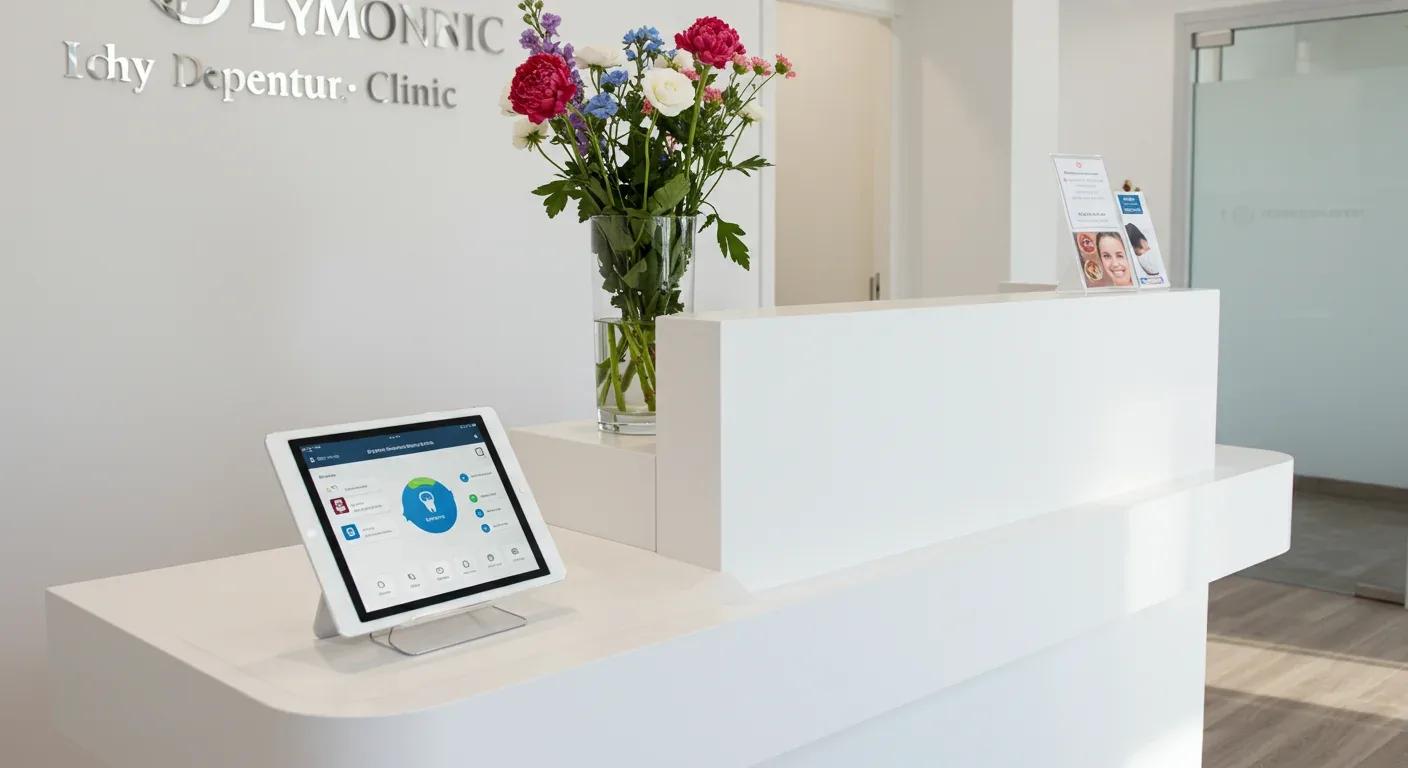
What you will learn
\n- \n
- Why dental clinics in 2025 need an AI chatbot, not just a contact form \n
- The five biggest patient-flow pain points in a dental practice \n
- How an AI chatbot for dentists solves each one, end-to-end \n
- Integrations that matter: practice management, calendars, WhatsApp \n
- DPDP Act 2023 and Dental Council of India compliance for chatbots \n
- Multilingual support: Hindi, Marathi, Tamil, Telugu, Bengali and more \n
- What is the realistic ROI in your first 30 days? \n
- How AIChatBot handles dental practices end-to-end \n
- 10-step setup guide for your dental clinic \n
- Common mistakes dentists make when deploying chatbots \n
- Real examples: Mumbai, Bengaluru, Delhi, Pune practices \n
- Frequently asked questions \n
Why dental clinics in 2026 need an AI chatbot, not just a contact form
\n\nIndian dental practices have moved past the website-with-a-contact-form era. Patients now expect to book on WhatsApp at 11 pm, ask if you accept their insurance before they call, and reschedule a recall in two taps. A static contact form does none of that.
\n\nThe average dental practice still loses about 15% of booked patients to no-shows, and during festival season or after a holiday weekend, that number climbs to 25-30%. A modern conversational ai chatbot closes that gap by reaching the patient at the moment they want to act, not three hours later when your receptionist gets to the message.
\n\nThe shift is also competitive. New patients in cities like Bengaluru and Pune compare three or four clinics before they pick one. The clinic whose website answers fees, timings, dentist credentials, and Saturday slot availability in 30 seconds wins. The one that says "call us during business hours" loses.
\n\nThis is not about chasing tech for tech's sake. It is about answering the question the patient already asked, at the time they asked it, in the language they asked it in.
\n\nThe five biggest patient-flow pain points in a dental practice
\n\nBefore you shop for tools, name the leaks. Most clinics have the same five.
\n\n1. After-hours queries vanish
\nPatients search for "emergency dentist near me" at 9 pm on a Sunday. If your phone rolls to voicemail and your website only has a contact form, that lead is calling the next clinic on the list within 90 seconds.
\n\nSolo practitioners in tier-2 cities lose 8-15 inbound enquiries every week to after-hours silence. At an average lifetime patient value of around Rs. 18,000-45,000 across general dentistry, ortho, and implants, that is real money walking past your door.
\n\n2. No-shows and last-minute cancellations
\nThe Becker's Dental Review benchmark is 15% no-shows for general dentistry. Indian clinics often run higher, because patients juggle public-transport delays, family obligations, and "I will just call them when I leave" intentions that never happen.
\n\nEvery empty chair is two things at once: a chair-time cost (your hygienist is paid, your dentist's hour is gone) and an opportunity cost (a waitlisted patient could have filled it). A 30% no-show rate on a 25-chair-day practice is roughly Rs. 1.2-1.5 lakh of lost revenue per week.
\n\n3. Recall reminders that never go out
\nSix-month recalls are the lifeblood of a general practice. Most clinics rely on a junior staff member sifting through last year's appointment book and calling 30-50 patients a day. That works for the first 200 names and breaks at the 500th.
\n\nThe recall list grows faster than your reception team can chase it. Within 18 months, half your past patients are out of cycle, and the chair time their recalls would have filled is sold to walk-ins or sits empty.
\n\n4. Insurance and pricing pre-checks eat staff hours
\n"Do you accept Star Health?" "What is your charge for RCT on a molar?" "Will the implant package include the crown?" Your front desk answers the same eight questions 50 times a week. Each call is 4-7 minutes of staff time that is not booking, not collecting payment, not greeting the patient walking in.
\n\nMultiplied across the week, that is roughly 18-22 hours of human labour spent reading from a price sheet.
\n\n5. Post-op follow-up is inconsistent
\nThe patient who had a wisdom tooth extracted on Tuesday should hear from you Wednesday morning. Most do not. They Google their symptoms instead, panic, and the next contact you have with them is a one-star review or an emergency walk-in to a competitor.
\n\nConsistent post-op follow-up takes recall rates from 60% to over 85%, but only if it actually happens. Manual follow-up does not scale past 30 active post-ops.
\n\n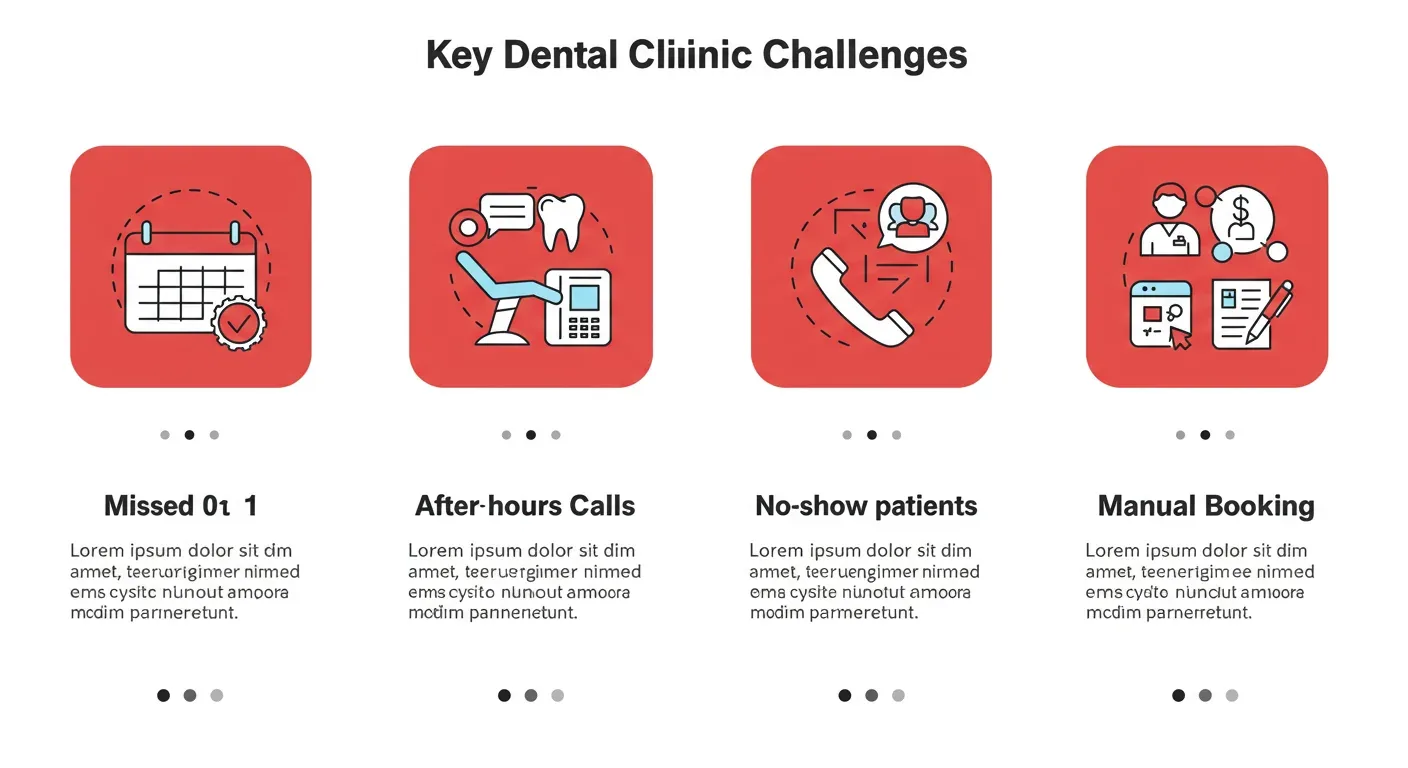
How an AI chatbot for dentists solves each one, end-to-end
\n\nAn ai chatbot platform does not magically fix patient flow. The right one fixes specific gaps with specific automations. Here is how each pain point closes.
\n\nAfter-hours: 24x7 booking and triage
\nThe chatbot sits on your homepage, your booking page, your Google Business Profile link tree, and your WhatsApp number. When someone asks for an emergency slot at 10:30 pm on Sunday, the bot:
\n- \n
- Confirms the urgency with two qualifying questions (pain level, swelling, bleeding) \n
- Books the next available emergency slot in your calendar \n
- Sends a confirmation with arrival instructions and pre-visit forms \n
- Pings the on-call dentist via Slack or WhatsApp if the case is genuinely urgent \n
The patient gets an answer in 8 seconds instead of waiting 12 hours. Your on-call dentist gets context before they walk in Monday morning.
\n\nNo-shows: layered reminders that actually work
\nReminder timing is the single biggest lever on no-show rates. Studies show automated reminders cut no-shows by 22-35%. The schedule that works:
\n- \n
- T-48 hours: WhatsApp confirmation with one-tap reschedule link \n
- T-24 hours: SMS reminder with directions and dentist name \n
- T-2 hours: WhatsApp ping "on your way?" with a one-tap "running late" reply \n
- T-30 minutes: If no confirmation yet, the bot proactively releases the slot to the waitlist \n
The waitlist trigger is the part most clinics skip. It is also the part that turns no-shows from a loss into a revenue swap.
\n\nRecalls: automated, segmented, never-missed
\nOnce your patient list is in the chatbot's reach (via your practice management software integration), the bot runs a continuous recall queue. Six months after the last cleaning, a personalised WhatsApp message goes out with three suggested slots and a one-tap booking link.
\nThe patient books in 11 seconds. Your reception staff never lifted a phone. The drip campaign keeps following up at 7 days, 14 days, and 30 days if the first message goes unanswered, then escalates to a human follow-up only for the cold ones.
\n\nInsurance and pricing: knowledge-base answers in real time
\nUpload your insurance partners list, your fee schedule, your package details, and your dentist credentials to the chatbot's RAG knowledge base. From that point on, every "do you accept X?" or "what is the cost of Y?" gets a precise answer in 4 seconds, sourced from your own documents.
\nIf the question is too specific ("will my Star Health Senior Citizen plan cover this?"), the bot collects the patient's policy number and routes to a human, not a generic "please call us".
\n\nPost-op: scripted follow-up the patient actually feels
\nThe chatbot fires a follow-up sequence the moment a procedure is marked complete in your calendar:
\n- \n
- Day 1: "How is the swelling today? Reply 1 (fine) / 2 (worried) / 3 (need help)" \n
- Day 3: Care reminders, what to eat, what to avoid \n
- Day 7: Suture-removal reminder if relevant \n
- Day 30: Recall booking for the next visit and a Google review request \n
If the patient replies "need help" at any point, the bot escalates to your duty dentist instantly. Eight in ten patients never need that escalation. The two who do get faster help than they would have gotten through your phone line.
\n\nIntegrations that matter: practice management, calendars, WhatsApp
\n\nAn ai chatbot for dental clinics is only as useful as the systems it talks to. Pick a tool that integrates with what you already run, not one that asks you to switch.
\n\nPractice management software
\nThe chatbot needs to read your appointment calendar in real time and write back confirmed bookings. The Indian dental tech stack is fragmented, but the chatbot should integrate with at least:
\n- \n
- Practo Ray (most common for solo and small group practices in India) \n
- Dentrix Ascend, Eaglesoft, Curve (DSOs and larger clinics) \n
- Custom EMRs via REST API or webhook \n
- Google Calendar / Microsoft 365 calendar for solo practitioners running lean \n
If your software has no API, ask the chatbot vendor about CSV-sync or email-parser fallbacks. They are not as elegant but they keep the bookings flowing while you migrate to a real API stack.
\n\nWhatsApp Business
\nWhatsApp is non-negotiable in India. 92% of dental patients in a Practo 2024 survey said they prefer WhatsApp to email and SMS combined. Your chatbot should connect to your WhatsApp Business number through the official Cloud API, not a grey-market reseller.
\n\nWhy direct Cloud API matters: green-tick verification, message-template reliability, and DPDP-friendly data handling. Resellers cut corners on all three and get accounts banned during festival peaks when you can least afford it.
\n\nPayment and CRM
\nRazorpay, PayU, or Cashfree for booking deposits. Zoho CRM, Salesforce, or a simple Google Sheet for the patient list. The chatbot should push every captured lead to your CRM with the conversation transcript attached, so when your treatment coordinator follows up, they have full context.
\n\n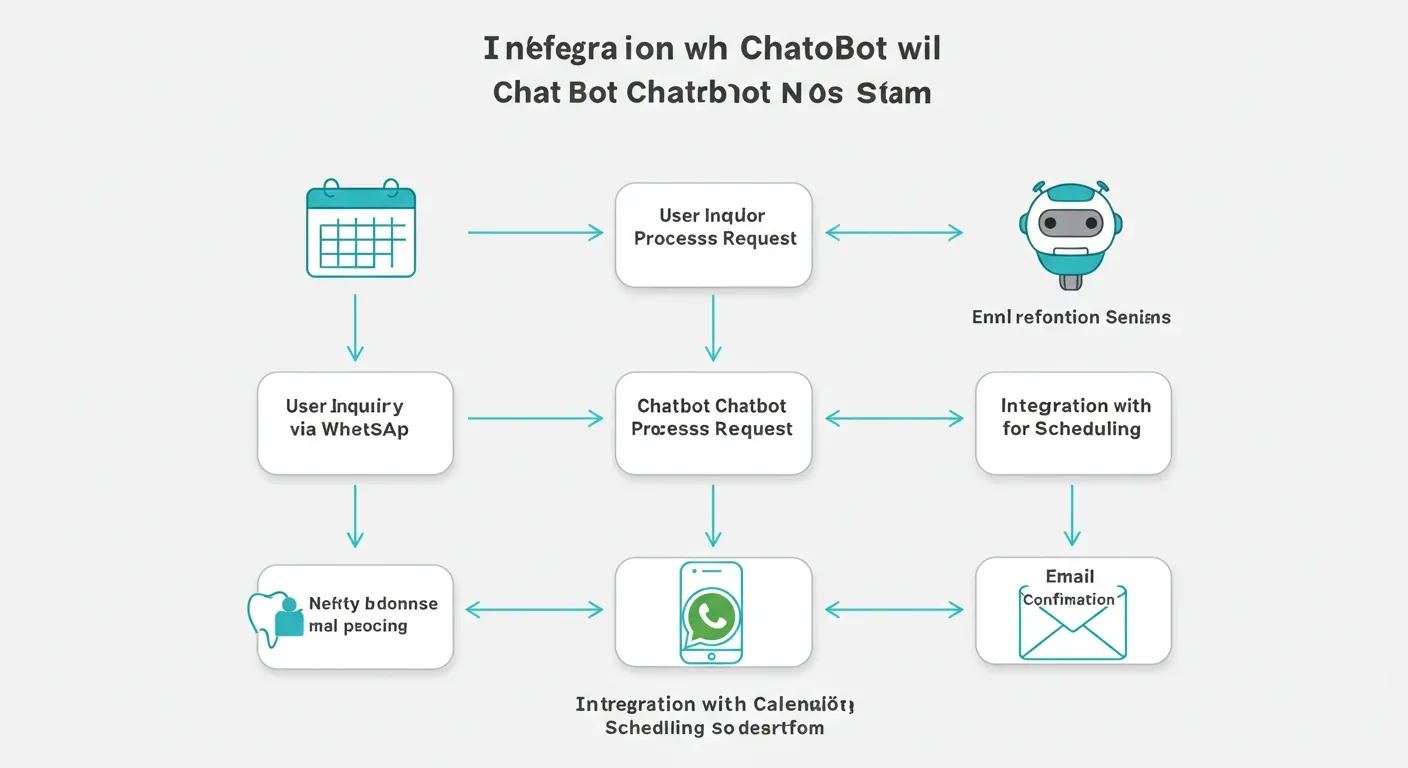
DPDP Act 2023 and Dental Council of India compliance for chatbots
\n\nHealth data in India is now legally classified as sensitive personal data under the Digital Personal Data Protection Act 2023. Dental clinics are data fiduciaries the moment they collect a patient's name, phone, and chief complaint. Your chatbot is part of that responsibility.
\n\nWhat the DPDP Act 2023 requires
\n- \n
- Explicit consent before collecting personal data, with a clear statement of purpose \n
- Right to withdraw consent, with the same ease as giving it \n
- Data minimisation: collect only what you need to book, treat, and recall \n
- Retention limits: delete data when the stated purpose is fulfilled \n
- Breach notification to the Data Protection Board within strict timelines \n
- Designated grievance officer the patient can reach \n
How to make your chatbot DPDP-compliant from day one
\n- \n
- Show a one-line consent banner on first interaction: "We use your details to book your appointment and send reminders. Reply STOP to opt out anytime." \n
- Never log full medical history in the chatbot's working memory. Capture only the booking-relevant fields. Detailed clinical notes belong in your EMR, behind staff login. \n
- Encrypt patient data at rest (AES-256) and in transit (TLS 1.2 or higher). Reputable platforms do this by default. \n
- Sign a data processing agreement (DPA) with your chatbot vendor. They are your data processor under DPDP. \n
- Set clear retention windows: chat transcripts purged after 90 days, booking records as per your standard EMR policy. \n
- Publish a privacy policy that names the chatbot and explains how it uses patient data. \n
Dental Council of India norms
\nThe DCI 2002 Code of Ethics governs how dentists communicate with patients. Two rules matter for chatbots:
\n- \n
- No diagnosis without examination. Your chatbot must triage, not diagnose. The bot can ask about pain level and swelling, but it cannot tell a patient "you have an abscess". Use the words "this sounds urgent, let us see you today" instead of clinical labels. \n
- No misleading claims. Avoid superlatives like "best dentist in Pune" in chatbot scripts. Stick to verifiable facts: years in practice, qualifications, treatment options. \n
This is also a place to be honest with the reader: AI is not yet a substitute for a clinician's judgement. The bot's job is to triage, schedule, and inform. Your dentist still owns the diagnosis and treatment plan.
\n\nMultilingual support: Hindi, Marathi, Tamil, Telugu, Bengali and more
\n\nIndia has 22 scheduled languages and a patient base that types in whichever feels most natural at 9 pm on a Sunday. A patient in Pune might open the chat in Marathi, switch to English mid-conversation, then drop a sentence in Hinglish about their root canal cost.
\n\nA modern conversational AI chatbot for dental clinics handles this transparently. The bot reads the input language, replies in the same language, and stores the canonical version (English) for your team to read. The patient feels heard. Your reception staff does not need to learn five languages overnight.
\n\nPractical impact: tier-2 and tier-3 city clinics in Nashik, Surat, Indore, Coimbatore, and Bhubaneswar see a 30-45% lift in chatbot completion rates when multilingual mode is on, compared to English-only bots. The patients were always there. They just were not going to type in English to ask if you take cash.
\n\nWhat is the realistic ROI in your first 30 days?
\n\nSkip the breathless "10x your revenue" pitches. Here is what an honest 30-day window looks like for a single-location, 4-chair dental practice in a Tier-1 Indian city, charging at typical mid-market rates.
\n\nThe baseline (before chatbot)
\n- \n
- Inbound enquiries per week: 60 \n
- Booked from those enquiries: 38 (63% conversion) \n
- No-show rate: 18% \n
- Recall response rate: 22% \n
- Average revenue per booked appointment: Rs. 2,400 \n
After 30 days with the chatbot
\n- \n
- Inbound enquiries handled: 60 plus 14 after-hours captures (+23%) \n
- Booked from those: 56 (76% conversion thanks to instant response) \n
- No-show rate: 11% (38% reduction from layered reminders) \n
- Recall response rate: 41% (almost double, from automated WhatsApp recalls) \n
- Net new appointments per week: +18 \n
- Net new monthly revenue: ~Rs. 1.7 lakh \n
The cost
\nA practical AI chatbot for a single-location practice runs Rs. 3,999-6,999/month on the AIChatBot Standard plan, billed via Razorpay. That is roughly 2-3% of the monthly revenue lift. The chatbot pays for itself in the first week.
\n\nFor a 5-location group practice, the lift compounds. The same bot plays receptionist across all locations, the recall queue runs centrally, and the marketing manager finally has accurate per-location numbers in one dashboard.
\n\n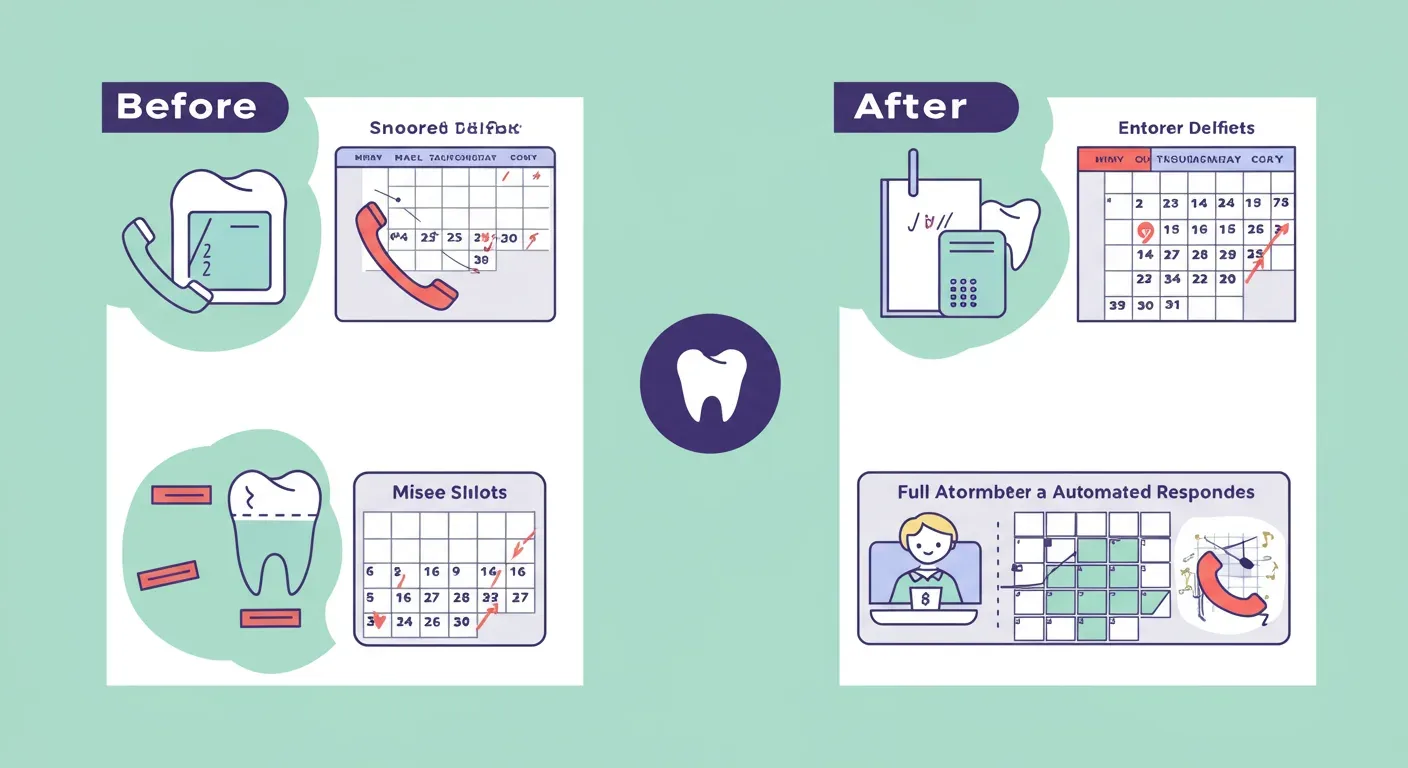
How AIChatBot handles dental practices end-to-end
\n\nAIChatBot is built around the same five gaps every dental clinic has. The features map directly:
\n\nSee the full AI dental clinic chatbot for India product page for pricing, live demo, and the complete feature list.
\n\nAppointment booking with calendar sync and reminders
\nThe booking module connects to Practo Ray, Google Calendar, and Microsoft 365 in two clicks. Patients see only your real availability, get a confirmation in their preferred channel, and receive the four-touch reminder sequence (T-48h, T-24h, T-2h, T-30m) without your reception team writing a single message.
\n\nRAG knowledge base for fees, insurance, and dentist credentials
\nUpload your fee sheet, insurance partner list, dentist bios, and clinic policies once. AIChatBot's RAG knowledge base service indexes them into searchable vectors. From that point, the bot answers "do you accept Star Health?" and "what is the cost of zirconia crown?" with sourced precision, not generic guesses.
\n\nWhatsApp Business AI integration
\nThe WhatsApp integration uses the official Meta Cloud API. Your number gets the green tick, message templates pre-approved by Meta deliver reliably, and the same bot that talks on your website also talks on WhatsApp. One conversation, multiple channels.
\n\nLead routing to email, Slack, or your CRM
\nEvery captured patient lead, every emergency triage, every insurance pre-check enquiry routes to the right destination by rule. Emergencies ping your duty dentist's WhatsApp. New patient enquiries land in your treatment coordinator's email with the full chat transcript. Cold leads flow to your CRM for drip-campaign follow-up.
\n\nDrip campaign automation triggered by chat behaviour
\nDrip campaign automation runs the recall queue, the post-op follow-up sequence, and the new-patient nurture flow without manual scheduling. Each campaign triggers on chat behaviour: a patient who asked about whitening but did not book gets a 3-message educational drip; a patient who completed an extraction gets the post-op care sequence.
\n\nMultilingual support across 50+ languages
\nThe multilingual layer handles Hindi, Marathi, Tamil, Telugu, Bengali, Kannada, Malayalam, Gujarati, and Punjabi natively, plus English, Hinglish, and 40+ other global languages for clinics serving expat patients.
\n\nVoice AI receptionist (in beta)
\nFor practices that get heavy phone volume, the voice AI receptionist (currently in beta) handles inbound calls in the same languages, books appointments, and triages emergencies just like the chat bot. It augments your front desk during peak hours rather than replacing them.
\n\nThe 4-layer product, applied to dentistry
\nAIChatBot is structured in 4 layers. For a dental clinic, that maps as follows:
\n- \n
- Layer 1 (Lead Capture): The website chatbot, the WhatsApp bot, the after-hours triage \n
- Layer 2 (Lead Management): The mini-CRM, lead routing, treatment coordinator handoff \n
- Layer 3 (Growth Automation): Drip campaigns, recall reminders, post-op sequences, Google review requests \n
- Layer 4 (AI Business OS): Reporting, no-show analytics, recall queue health, per-dentist productivity \n
You start at Layer 1 in your first weekend. By month 3, you are running on all four.
\n\n10-step setup guide for your dental clinic
\n\nThis is the sequence we walk Indian dental practices through during onboarding. A solo practitioner can finish it in a weekend. A 5-chair clinic with a treatment coordinator finishes in a week.
\n\nStep 1: Pick your top 3 patient flows
\nDo not try to automate everything on day one. Pick the 3 highest-volume flows: new patient enquiry, appointment booking, recall reminder. Get those working first, then layer in post-op follow-up, insurance pre-check, and emergency triage.
\n\nStep 2: Write your knowledge base
\nCompile one document with your fees, insurance partners, dentist credentials, clinic timings, holiday schedule, and FAQ answers. Keep it factual and short. The chatbot will not paraphrase well from a 50-page brochure but it will be sharp from a 5-page fact sheet.
\n\nStep 3: Connect your calendar
\nSign in to your practice management software or Google Calendar through the chatbot's integration screen. Confirm appointment durations per procedure (cleaning 30 min, RCT 90 min, extraction 45 min). Block your lunch and dentist day-offs.
\n\nStep 4: Upload to the RAG knowledge base
\nDrop your knowledge base document into AIChatBot's RAG service. Wait 60 seconds for indexing. Test by asking the bot "do you accept HDFC ERGO?" and check the answer is sourced from your document, not a hallucination.
\n\nStep 5: Connect WhatsApp Business
\nAdd your WhatsApp Business number, complete the Meta verification (15-minute process), and pre-approve your message templates. Use AIChatBot's pre-built dental templates for confirmation, reminder, and recall as a starting point.
\n\nStep 6: Configure the reminder sequence
\nSet the four-touch reminder schedule (T-48h, T-24h, T-2h, T-30m). Pick the tone: formal Hindi, casual Marathi, professional English. Test by booking yourself a fake appointment and watching the reminders fire.
\n\nStep 7: Set up lead routing
\nDecide who gets what. Emergency triages to the duty dentist. New patient enquiries to your treatment coordinator. Cold website chats to your CRM. Configure each rule in the lead routing module.
\n\nStep 8: Build your recall queue
\nImport your last 12 months of patient records into the recall queue (CSV upload works if your PMS does not have a direct integration). The chatbot fires the first wave of recalls 24 hours after import, then maintains the queue continuously.
\n\nStep 9: Add the widget to your website and Google Business Profile
\nPaste the embed snippet into your website (one line of HTML). Add your WhatsApp link to your Google Business Profile and your Instagram bio. The bot is now live in three places.
\n\nStep 10: Train your team and go live
\n15-minute team training: how to read a chatbot transcript, how to take a handoff from the bot, how to override the bot's recommendation when needed. Then turn it on and watch the first 48 hours closely. Most issues surface and resolve in the first 2 days.
\n\n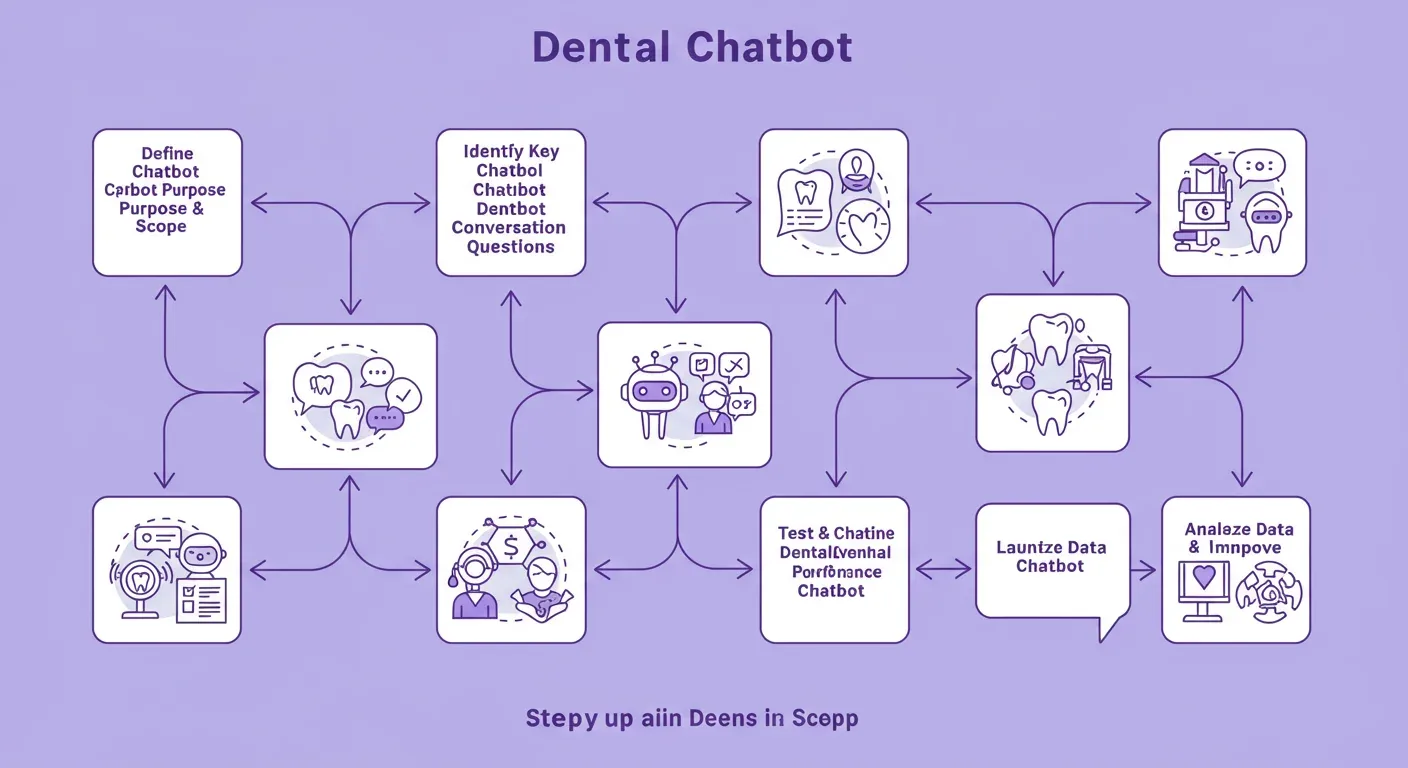
Common mistakes dentists make when deploying chatbots
\n\nMost failed chatbot deployments share a small set of root causes. Avoid these and you skip 80% of the pain.
\n\nMistake 1: Trying to automate every conversation
\nThe bot is best at the repetitive 80% (booking, reminders, FAQs). The remaining 20% (clinical judgement, complex insurance disputes, anxious first-time patients) is human work. Mark those handoff points clearly. A bot that pretends to handle everything ends up handling nothing well.
\n\nMistake 2: Generic, brand-less scripts
\nIf your bot's greeting is "Hello, how can I help you today?" it sounds like every other bot. Patients tune out. Make the greeting specific: "Welcome to Smile Studio, Bandra. I can book your appointment, share fees, or answer insurance questions in 30 seconds. Where do we start?"
\n\nMistake 3: Skipping the consent banner
\nThis is a DPDP violation waiting to happen. Every first interaction needs the one-line consent statement. It also builds trust with the patient.
\n\nMistake 4: Ignoring the handoff edge cases
\nWhat happens at 11 pm when a patient says "I am bleeding, what do I do?" Your bot needs an escalation path that wakes the duty dentist via WhatsApp or phone. If the bot's only response is "please call us in the morning", you have built a liability, not an asset.
\n\nMistake 5: No one watches the dashboard
\nThe chatbot generates rich data: which times have peak enquiries, which procedures get the most price questions, which dentists have the most no-shows. Most clinics never look. Assign one person (your practice manager) 15 minutes a week to review the dashboard. The optimisation compounds.
\n\nMistake 6: Picking a vendor without dental experience
\nGeneric chatbot platforms work, but they need 60-80 hours of customisation to match a dental workflow. A platform that has dental templates, a dental-specific knowledge base structure, and dental clinic case studies cuts that to 4-8 hours.
\n\nReal examples: Mumbai, Bengaluru, Delhi, Pune practices
\n\nMumbai: Bandra-based 4-chair general practice
\nA four-chair family dental practice in Bandra West rolled out an ai chatbot for dentists in October 2024. The before-state: 21% no-show rate, 14 hours/week of front-desk time on phone calls, recall response under 25%. After 60 days: no-show rate at 12%, front-desk phone time down to 7 hours/week, recall response at 39%. Net new monthly revenue ~Rs. 2.1 lakh, against a chatbot cost of Rs. 3,999/month.
\n\nBengaluru: Indiranagar 3-location ortho practice
\nAn ortho-only group with locations in Indiranagar, HSR Layout, and Koramangala automated its consultation-booking flow and post-aligner-fitting follow-up. The chatbot now handles 1,400 conversations/month across the three locations, books 280 consultations/month directly, and reduced consultation no-shows from 28% to 14%. The practice manager went from a 50-hour week to 38.
\n\nDelhi: South Delhi solo implantologist
\nA solo implant specialist in Greater Kailash uses the chatbot mainly as an after-hours triage and pricing-FAQ tool. Result: 18 implant consultations/month captured from after-hours and weekend enquiries that previously went to voicemail. Average implant package value Rs. 38,000, conversion to actual treatment ~40%. That is Rs. 2.7 lakh of net new monthly revenue, attributable directly to the bot.
\n\nPune: Kothrud 6-chair family practice
\nA six-chair practice in Kothrud, Pune adopted the bot in Marathi-and-English mode. The Marathi-first patient population (predominantly senior citizens) engaged at 3x the rate they did with the previous English-only contact form. Recall response went from 19% to 47% within 8 weeks. The practice manager called it "the cheapest receptionist we ever hired, and she works at 11 pm".
\n\nFrequently asked questions
\n\nWill an AI chatbot for dentists replace my receptionist?
\nNo. The chatbot handles the repetitive 80% (booking, reminders, FAQs, recalls) so your receptionist can focus on the 20% that needs a human: greeting walk-ins, handling anxious patients, managing same-day complications, coordinating between dentists. Most clinics keep the same headcount and reassign hours to higher-value tasks. A few clinics scale to 2x the patient volume on the same team. None we have worked with have laid anyone off because of the bot.
\n\nHow does the chatbot stay DPDP Act 2023 compliant?
\nThree layers of protection. First, an explicit consent banner on every first interaction. Second, data minimisation: the bot only collects fields needed for booking and reminders, never full medical history. Third, encryption at rest (AES-256) and in transit (TLS 1.2+), with a signed Data Processing Agreement between the clinic and the chatbot vendor. Plus retention windows: chat transcripts purged after 90 days unless your retention policy says otherwise.
\n\nHow long does it take to set up?
\nA solo practitioner with a clear knowledge base can finish in a weekend. A 4-6 chair clinic typically takes 4-7 working days. A multi-location DSO with 5+ branches plans for 2-3 weeks. The longest part is usually writing the knowledge base; the technical setup itself is under 4 hours.
\n\nWhat does an AI chatbot for a dental clinic cost in India?
\nAIChatBot starter plan begins at Rs. 499/month for solo practitioners with up to 500 conversations. The Standard plan at Rs. 3,999-6,999/month suits 4-10 chair practices with WhatsApp integration, RAG knowledge base, and unlimited drip campaigns. Multi-location group practices typically run on the Business plan starting Rs. 9,999/month with central reporting across locations. All plans bill via Razorpay.
\n\nWill the bot work in Hindi, Marathi, Tamil, or other Indian languages?
\nYes. AIChatBot supports Hindi, Marathi, Tamil, Telugu, Bengali, Kannada, Malayalam, Gujarati, and Punjabi as first-class languages, plus 40+ others. The bot reads the patient's input language and replies in the same one, while storing canonical English transcripts for your team. Tier-2 and tier-3 city clinics typically see a 30-45% lift in chat completion rates after switching to multilingual mode.
\n\nCan the chatbot integrate with Practo Ray and other practice management software?
\nYes. Practo Ray, Dentrix Ascend, Eaglesoft, and Curve integrate via API. For other systems, AIChatBot supports CSV import, webhook integration, and Google Calendar / Microsoft 365 calendar sync. If your clinic runs a custom EMR, the engineering team can build a connector in 1-2 weeks.
\n\nWhat happens when a patient asks something the bot cannot answer?
\nThe bot is configured with explicit handoff rules. If a question is outside its scope (clinical diagnosis, complex insurance dispute, escalated emergency), it apologises briefly and routes to the right human: your duty dentist via WhatsApp for emergencies, your treatment coordinator via email for complex enquiries, or your reception during business hours for everything else. The patient never hits a dead end.
\n\nRelated guides for dental practices
\n- \n
- AI chatbot for doctors and medical clinics: complete guide \n
- AI chatbot for healthcare: HIPAA, DPDP, and patient flow \n
- Appointment booking chatbot: 24x7 calendar, zero no-shows \n
- WhatsApp chatbot for clinics: setup, templates, compliance \n
- How to reduce no-shows at your dental clinic in 30 days \n
- DPDP Act 2023 compliance for healthcare: a clinician's guide \n
- Best AI chatbot platform for SMBs in 2025 \n
Ready to see this for your clinic?
\nEvery dental practice has a slightly different patient flow, fee structure, and language mix. Generic demos waste your time. Get My Free Demo and AIChatBot will spin up a personalised demo website with your clinic name, fees, and dentist details mocked in, so you can test the chatbot against your actual workflow before you ever sign up.
\n\n